Electrostatic MACE
We introduce MACE-POLAR-1, a new family of foundation models that extends the MACE architecture with explicit long-range electrostatics. MACE-POLAR-1 augments local atomic energies with a non-self-consistent polarisable field formalism, learning atomic charge and spin densities — represented as multipole expansions in a Gaussian-type orbital basis — directly from energy and force labels alone. Global charge and spin constraints are enforced through learnable Fukui equilibration functions, enabling the model to handle arbitrary charge and spin states and respond to external electric fields, while providing physically interpretable spin-resolved charge densities.
The models are trained on the OMol25 dataset comprising 100 million structures at the ωB97M-V hybrid DFT level of theory. Two variants are available: MACE-POLAR-1-M (medium, 12 Å receptive field) and MACE-POLAR-1-L (large, 18 Å receptive field).
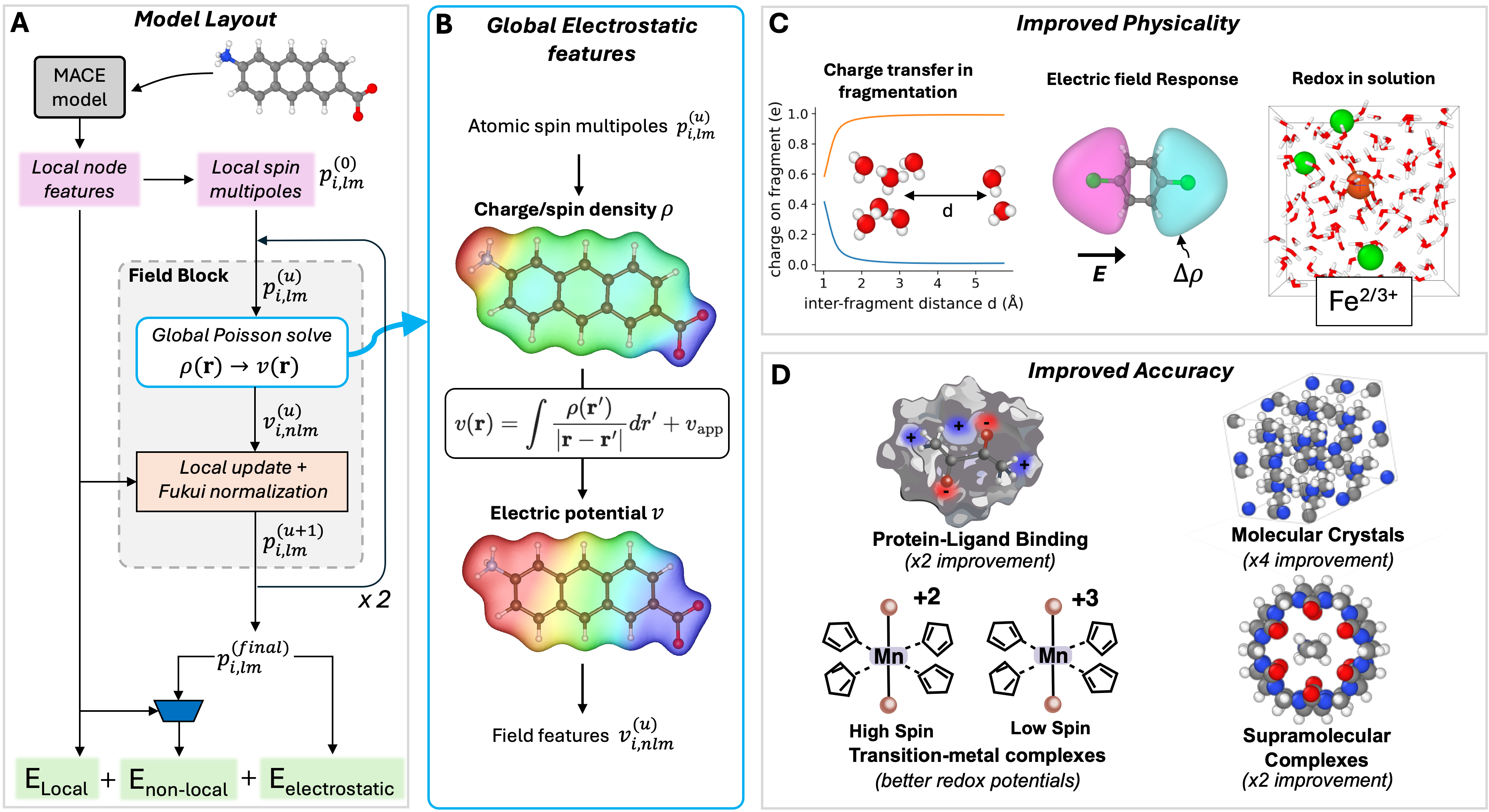
Overview of the PolarMACE model layout, global electrostatic features, improved physicality, and improved accuracy across benchmark tasks.
Architecture Summary
PolarMACE keeps the local MACE backbone for short-range chemistry and adds a non-self-consistent long-range update on spin-resolved atomic multipoles. Each update builds non-local electrostatic features from a smooth multipolar density, predicts local multipole corrections, then applies global Fukui equilibration to enforce total charge and spin. The final energy is the sum of local, explicit electrostatic, and learned non-local terms.
Installation
You will need mace-torch version 0.3.16 or newer
pip install mace-torch
pip install git+https://github.com/WillBaldwin0/graph_electrostatics.git@v0.4.4
graph_electrostatics provides the Python module namespace graph_longrange, which PolarMACE requires at runtime.
Available Checkpoints
polar-1-s— smallpolar-1-m— mediumpolar-1-l— large
Basic Inference
Use the dedicated mace_polar loader, which handles model type and path resolution automatically:
from mace.calculators import mace_polar

calc = mace_polar(
    model="polar-1-m",
    device="cpu",            # or "cuda"
    default_dtype="float64", # use float32 for faster MD
    pbc_handling="auto",      # see below for the available modes
)

atoms.info["charge"] = 0
atoms.info["spin"] = 1
atoms.info["external_field"] = [0.0, 0.0, 0.0]
atoms.calc = calc

energy = atoms.get_potential_energy()
forces = atoms.get_forces()
stress = atoms.get_stress()
When using a mace_polar model, specify the boundary conditions for the
electrostatic operations. Available modes are pbc (Ewald summation), realspace (realspace sum),
slab (Ewald sum + dipole correction), and several other convenience modes. The auto mode
uses atoms.pbc to select the boundary conditions. See the
graph_electrostatics documentation
for more information.
Reading Dipole and Charge Density
# populate calc.results
_ = atoms.get_potential_energy()
Energy and Forces
Energies and forces are accessed in the usual ASE way via atoms.get_potential_energy()
and atoms.get_forces().
Total Dipole
mu = calc.results["dipole"] # shape (3,)
The total dipole is only a well-defined quantity for non-periodic systems. For periodic systems it is a meaningless value and should be ignored.
Partial Charges and Partial Dipoles
MACE-POLAR-1 stores atom-centered multipole coefficients as the final values of \(p^{lm}_i\) (spherical multipoles, Condon–Shortley phase convention):
# full multipole array, shape (n_atoms, 4)
p = calc.results["density_coefficients"]

# atomic monopole charges
atomic_charges = p[:, 0]

# cartesian atomic dipoles (px, py, pz)
atomic_dipoles = p[:, [3, 1, 2]]
Note
Partial charges and partial dipoles are not uniquely defined quantities. Furthermore, sums of these quantities over clusters or molecules are also not well defined in general. The only exception is summing over isolated fragments, where isolated means the fragment does not come within approximately 6 Å of any other atom.
Partial Spins
For models with spin support, a spin-resolved multipole array is also available:
# shape (n_atoms, 2, 4) — two spin channels, each with 4 multipole coefficients
p_spin = calc.results["spin_charge_density"]

# spin-up and spin-down atomic charges
charges_up   = p_spin[:, 0, 0]
charges_down = p_spin[:, 1, 0]
The sum across the two spin channels (axis 1) recovers the total density_coefficients
array above.
Fine-tuning from Polar Foundation Checkpoints
Use --foundation_model="polar-1-m" or --foundation_model="polar-1-l"
with --model="PolarMACE" in mace_run_train.
mace_run_train \
  --name="polar_ft_1m" \
  --model="PolarMACE" \
  --foundation_model="polar-1-m" \
  --train_file="train.xyz" \
  --valid_fraction=0.05 \
  --energy_key="REF_energy" \
  --forces_key="REF_forces" \
  --stress_key="REF_stress" \
  --loss="weighted" \
  --stress_weight=0.0 \
  --force_mh_ft_lr=True \
  --default_dtype="float64" \
  --device="cpu"